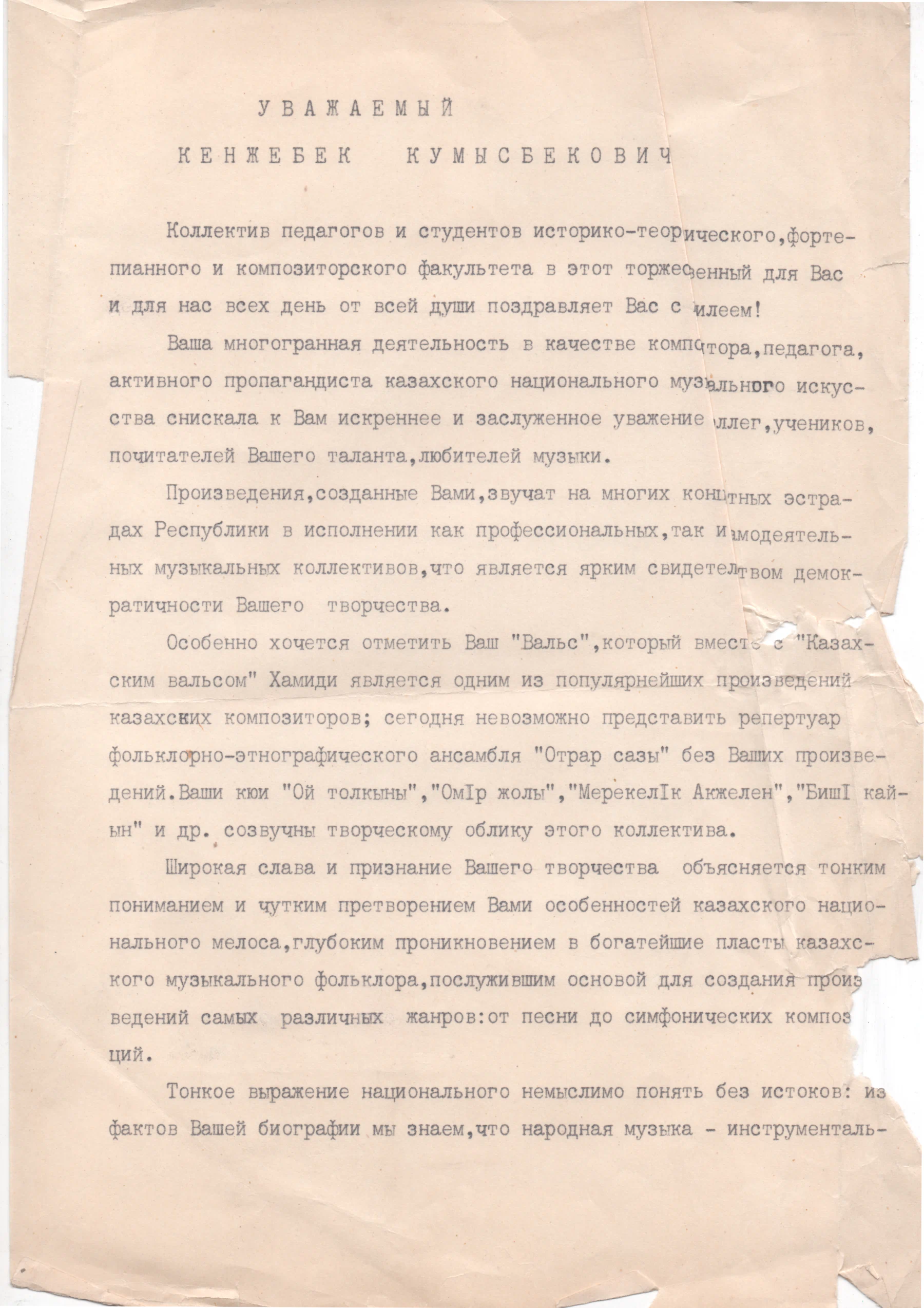
During one debate about musical notation, Kenzhebek Kumysbekov suggested that its opponents go out into the steppe and pitch a yurt. Many years later, the dombra player Karshyga Akhmediyarov relayed the remark in an interview with Talasbek Asemkulov.
Akhmediyarov placed it within his own argument: tradition must develop and had to be passed on; written notation helped make that possible. A second remembered episode continues the theme from another side — what must a new song possess if its bond with tradition is not to be broken?
The debate about notation
Akhmediyarov spoke about music passed from hand to hand and learned by ear. Tradition was not a museum object for him: it lived, changed and demanded transmission.
Against this background, Kumysbekov’s remark marked the limit of the debate. Akhmediyarov placed the suggestion of going to the steppe and pitching a yurt beside his own defence of notation. The written line did not abolish oral teaching: in his account, it helped musicians receive the music and pass it on.
The measure of a new song
The other episode is addressed not to people arguing about notation, but to young composers. In the book Dauir Duldulderi, the composer Tolegen Mukhamedzhanov remembers a shared rebuke from two senior composers — Sydyk Mukhamedzhanov and Kenzhebek Kumysbekov. In their view, the new songs lacked a distinctly Kazakh character.
Tolegen Mukhamedzhanov remembered these words as part of the education of young composers. The demand concerned the very measure of a new song: in creating one, an author should not lose national character.
In a television interview, Kumysbekov developed the thought: for him, the Kazakh language was not an addition to a melody, but a means of finding its intonation. Words about land and homeland required one kind of musical expression, personal grief another. National character began with the meaning of the word and the listening environment absorbed from childhood.
The written note as continuation
One episode arose in a debate about transmitting traditional music; the other in a conversation between older and younger composers. In both, continuation demanded work: the music had to be passed on without being locked in the past or dissolved in the new song.
In Akhmediyarov’s memory, written notes did not deprive music of the steppe: Kumysbekov’s remark defended the transmission of tradition. In Tolegen Mukhamedzhanov’s account, the demand placed upon the new song sounded in the shared voice of Sydyk Mukhamedzhanov and Kenzhebek Kumysbekov. National character remained its measure.