One day in Almaty, near the Opera and Ballet Theatre, the journalist Kaken Khamzin was walking beside Anuarbek Baizhanbayev — People’s Artist of the Kazakh SSR and an announcer on Kazakh Radio. Kenzhebek Kumysbekov approached and greeted them first. Baizhanbayev introduced him in a single phrase: a famous composer, a professor at the conservatory. Kumysbekov shook his head and waved both hands as if conducting, as though to say: his work was with the orchestra.
Khamzin described this meeting many years later. His account preserved what a professional record cannot: bearing, gesture, a brief introduction. Yet behind the words “composer and conservatory professor” stood thirty-two years — from his graduation in 1965 to the final year of his life. What filled those years?
Who decides what will be heard
His working life began in the same place as his studies. While still a student, Kumysbekov played dombra in the Kurmangazy Orchestra of Kazakh Folk Instruments — an ensemble named after the nineteenth-century dombra player and composer. He remained in the orchestra after graduating from the conservatory.
In 1965, after completing the composition faculty, he became music editor at the Kazakh State Philharmonic — the republic’s leading concert organisation. An editor decides what will be heard: which score enters a programme and what reaches the audience. Kumysbekov later worked as senior editor of the repertoire and editorial board at the Ministry of Culture of the Kazakh SSR, the body through which the repertoire of the republic’s concert ensembles passed.
A televised concert programme linked this experience directly to his orchestral writing: the dombra player who knew the ensemble from within went on to compose for the same kind of orchestra. His works included Dala Syry, Shalqyma and Farabi Sazy. Composer and editor met in one person: a musician who knew the orchestra from within and helped decide what it would perform.
The folk instruments department
From 1972 Kumysbekov taught orchestral conducting in the folk instruments department of the Alma-Ata Conservatory — the same institution in which he had travelled from the dombra class to composition. Orchestration and instrument studies were later added to conducting.
Decades later, students recalled his classes when speaking about their conservatory years. Kumysbekov’s own experience informed his teaching: he knew the dombra as a performer, the balance of an ensemble as an orchestral player, and the construction of a score as a composer. His work continued through the musicians who left that classroom.
Four titles
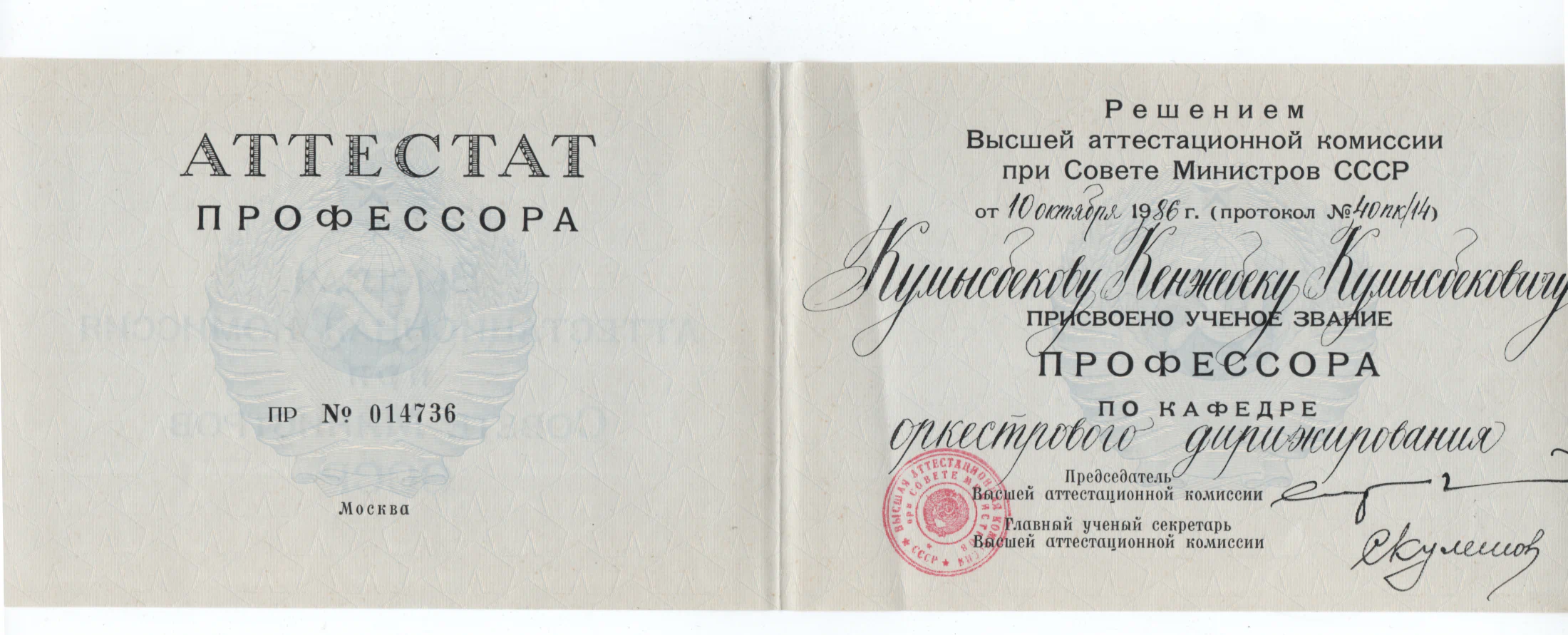
These years brought him four titles: People’s Artist of the Kazakh SSR, Honoured Art Worker of the Kazakh SSR, State Prize laureate and professor. Beside those four, the official announcement for a Philharmonic jubilee concert placed a fifth — dombra player. The beginning of the path was not forgotten.
An evening at home
At home, when the city grew quiet and the tea cooled on the table, he would take up the dombra again — and the music returned to its beginning. Three kinds of work — composer, editor, teacher — thus converged on one thing: the music heard in childhood.
What passed through his hands
Kenzhebek Kumysbekov died in Almaty in 1997. For thirty-two years — from his graduation in 1965 to the final year of his life — he worked with his country’s music in three roles: writing scores, deciding what would sound in programmes, and passing the craft to students.
The gesture near the Opera and Ballet Theatre was no accident. To conduct is to join many people in a single sound; that was what he did over a score, in repertoire work and in the classroom. The man who began as a dombra player in an orchestra became both the person who decided what would be heard and the person who prepared those who came next. Music passed through his hands and remained in the hands of those he taught.