Songs and kui, the Kazakh instrumental pieces of the dombra tradition, entered Kenzhebek Kumysbekov’s life at home. After his father’s early death, Ilyas Aubakirov became his mentor — a singer well known in the region and a connoisseur of its songs and kui. The boy learned much from him.
In an archival television interview Kumysbekov recalled his last encounter with his father: his father asked him to play a kui on the dombra, then died after the performance. The composer understood the request as a hope that his son would become a man of music.
This is how Altyn Imanbayeva opens the composer’s early biography. How did a dream of singing, interrupted by illness, lead Kumysbekov to the dombra, the orchestra and, finally, composition?
Singers of his native region
In his native region Kumysbekov heard Kosymzhan Babakov, a singer and connoisseur of song tradition; the singer Rabiga Yesimzhanova; and Daulet Myktybayev, a performer of kui and player of the qobyz, the Kazakh bowed instrument. Imanbayeva places these names beside Aubakirov to describe the musical circle of his early years.
One point of direction was especially clear. In a recollection relayed by Imanbayeva, Kumysbekov said that he imitated the singer Rabiga Yesimzhanova and dreamed of becoming a singer. The listening habits of home found a direction — the voice.
A victory and a doctor’s prohibition
In 1947 Kumysbekov won the All-Kazakhstan Olympiad of Folk Talents in Alma-Ata. E. K. Sapiyev names Akhmet Zhubanov and Latif Khamidi among the jury members: they advised the young performer to acquire a musical education.
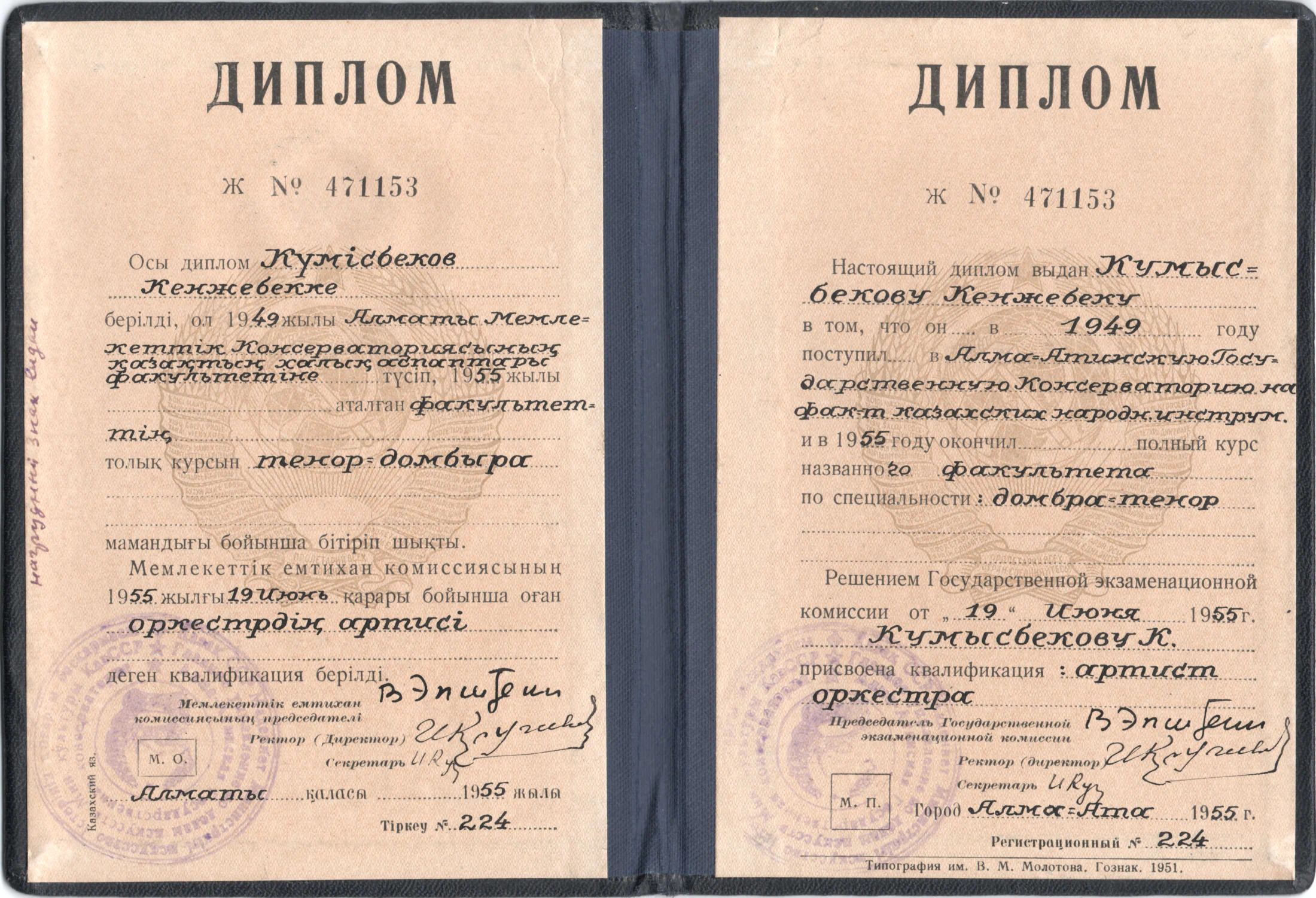
Military service followed the Olympiad. In 1949 Kumysbekov entered the vocal department of the Alma-Ata Conservatory. After six months a lung illness interrupted his studies: doctors prohibited him from singing, Sapiyev reports.
The path to a singing career closed. His path in music continued.
Dombra and orchestra
Kumysbekov moved to the dombra class. In Imanbayeva’s account, he first studied with Rustembek Omarov and completed his training with Kubysh Mukhitov.
During the 1950s Kumysbekov played dombra in the Kurmangazy Orchestra of Kazakh Folk Instruments. He arranged Russian and international classical music and helped the orchestra’s musicians. Performance became work upon a musical composition.
The first art song
The next turn came with his first art song, set to words by Abai — Qalqamai Men Undemei Zhuremin Kop. Kumysbekov showed it to Mukan Tulebayev, who advised him to study composition, Imanbayeva relates.
Kumysbekov entered the conservatory again and became a student of Yevgeny Brusilovsky. After voice, dombra, orchestra and arrangements came the years of studying composition.
From classroom to profession
In 1965, after graduating from the conservatory for a second time, Kumysbekov became music editor at the Kazakh State Philharmonic. He then worked as senior editor of the repertoire and editorial board at the Ministry of Culture of the Kazakh SSR.
The songs and kui of the home circle were the first step. Voice, dombra, orchestra, the first art song and Brusilovsky’s class followed. Thus a path that began among the singers of his native region led Kumysbekov into composition.