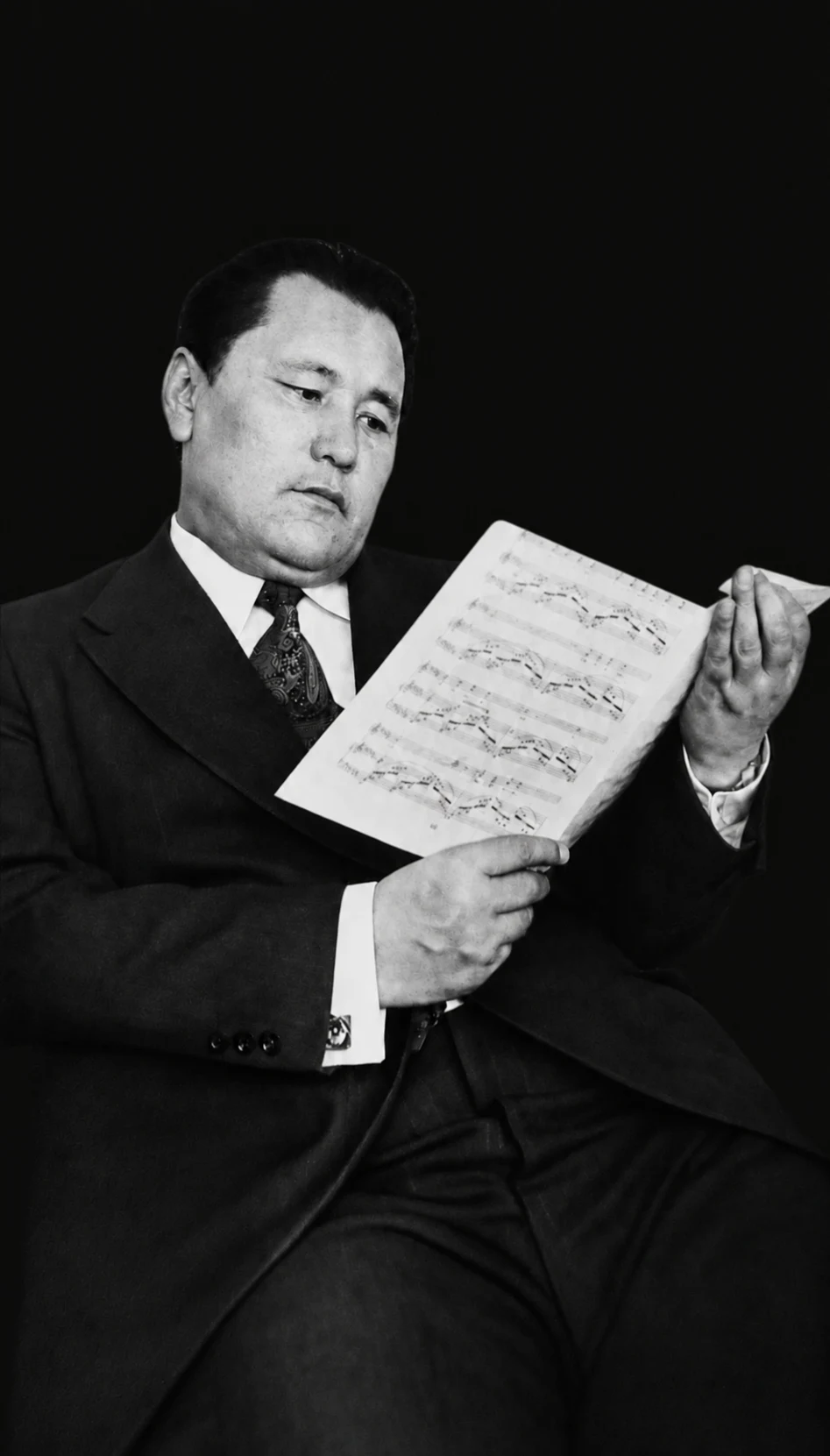
A grand piano that had been written off occupied almost half the Kumysbekovs’ rented room. The entire room measured about fifteen square metres. This was how the family remembered Kenzhebek Kumysbekov’s student years, in an account preserved by the television programme Personality, dedicated to the composer. They bought the instrument with a fee he had received and remembered it as the household’s greatest treasure.
The piano provided something he had lacked: a place to practise at home. Behind the orchestral scores he would write lay work for which space still had to be found. The family recollections bring that work into close view, from buying an instrument to finding the first listener for a new piece.
An instrument for study
Kumysbekov came to composition studies with experience as an orchestral player. He wrote songs and arranged music for the orchestra in which he worked. Now he was studying with Yevgeny Brusilovsky, a composer and teacher at the Alma-Ata Conservatory. The family account in Personality places those studies alongside daily hardship: a single wage, rented lodgings, and no instrument of his own.
He attended classes during the day and searched for somewhere to continue working in the evening. Conservatory practice rooms were allocated by timetable. Without an instrument at home, he had to wait for space elsewhere to become available. Buying the piano changed the rhythm of daily life: music had a permanent place in the room the family shared.
The instrument was not the end of the expense. Money went on records, sheet music and scores showing all the parts of a composition together. Buying them was as much a part of his education as attending classes. At home he gathered music to listen to, read again and study at the keyboard.
The first listener
A new composition did not arrive fully formed. In the same programme, someone close to Kumysbekov recalled how long he would work a piece over in his mind. Then he would invite them to listen, play one version, offer another, ask for their impressions, and return to the music.
This listener did not consider themselves a professional musician. They spoke of an inner ear and responded to what they heard without analysing compositional techniques. They recognised an independent voice in Kumysbekov’s music, unlike the work of other composers. He also sought a response from someone whose role was simply to listen.
In the family’s account, the distance between an idea and a finished piece was filled with long reflection, different versions, and conversations with those close to him. Kumysbekov listened to their responses before returning to the composition.
Musicians came to the house for scores
Musicians met Kumysbekov beyond the conservatory as well. One of the professional musicians interviewed in Personality recalled visiting the family, collecting scores, working on music, and drinking tea with the composer. Conversations continued during their work together and at meetings in cafés. The well-known composer remained approachable to someone who needed his score and advice.
Through these meetings, work done at home reached the performer. A musician could take the written music away and discuss it with the composer himself. In the interviewee’s recollection, the scores and the personal warmth belonged together: both the work and the ease of their conversations stayed with him.
The piano had once had to fit into half a small room. In time, the family remembered much more than the instrument: hours of study, purchases of scores, the search for the right version, the first listeners, and the musicians who came to the house. Large-scale orchestral music had this everyday measure: the work of one person learning to listen and giving others something to hear.