Music Among People

Six stories and three shorter forms: Kumysbekov's music was performed and preserved, a jubilee became a memorial evening, and his name passed to an orchestra, a city street, the screen and the airwaves.

Kumysbekov’s music did not live apart from people. Singers, dombra players, qobyz players — performers on the Kazakh bowed instrument — and large orchestras performed it; the family preserved recordings, students returned works to the stage, and musicians put into words what they heard in them. Later, an orchestra, a House of Culture and a city street took the composer’s name.

This path consists of six independent stories and three shorter forms. It leads from performance to preservation, and from remembrance to a name that continues its work among people.

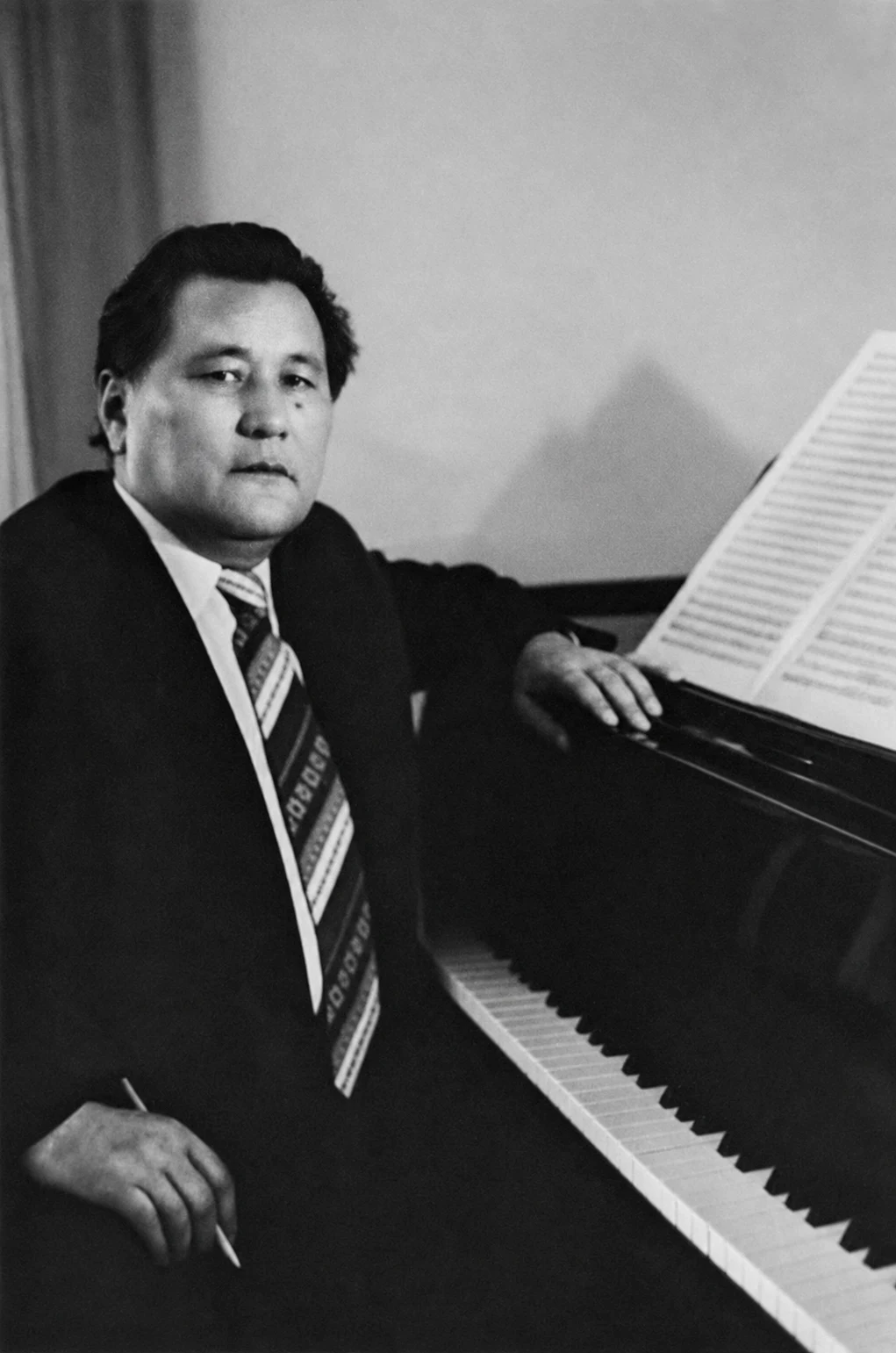
Family photograph of a man seated at a piano with an open score

01

Performed

Ten years separate two albums devoted to the composer. In 1977 four orchestral ensembles and three singers performed Kumysbekov’s music; in 1987 two orchestras and six vocal soloists filled the two sides. Only one title was shared by both track lists — The One and Only Waltz.

Two different ensembles stand at the outer edges of this discography. In 1966, Qalqama was recorded by the qobyz player Gulnafiz Bayazitova and the pianist Maria Smitrovich. In 1990, the singer Gafiz Yesimov, the Kurmangazy Orchestra and the conductor Shamgon Kazhgaliyev recorded My Native LandThe Orchestra in Which He Played.

In the songs, four poets and five voices appeared beside the composer. One song survives in two performances; another required a duet. The music thus continued through particular co-authors and singers: Songs and Their Poets.

02

Preserved

An old family player held eight complete orchestral recordings with a total running time of 41 minutes and 4 seconds. Waltz opens the sequence and Kerbezim closes it, with six more works between them in their former order. This is no longer a story about music but an invitation to listen — What the Old Player Preserved.

03

Remembered

The decisive turn came in 1997. Preparations for a concert marking Kumysbekov’s seventieth birthday had begun during his lifetime, but after his death it became an evening of remembrance. At the end of November, students and teachers from the Korgalzhyn music school performed his works — The Jubilee That Became an Evening of Remembrance.

Screen and airwaves preserved five more appearances of his name. In 1983 Kumysbekov took part in an edition of the television programme Tamasha featuring several performers; in 1992 he was the subject of a film made during his lifetime; in 2000 a television tribute was devoted to him. On 21 and 28 November 2021, two parts of a single radio programme were dedicated to him — A Name Among Names.

In February 2022 three musicians chose three measures of his art. Zhuzbay Zhangali spoke of the kui-poemkui is a Kazakh instrumental piece — Yermurat Usenov of national character, and Zhalgasbek Begendik of enough repertoire for four or five programmes: How Musicians Heard Him.

04

Given his name

On 25 January 2018, Dala Syry opened a concert by the Kumysbekov Orchestra. Four years later, eight of the composer’s works made up a concert devoted to him; in 2023 the ensemble hosted a festival finale with orchestras from Astana, Aktau, Semey and Taldykorgan. The name continued through the orchestra’s work — Dala Syry Once More.

Beyond the concert hall, the same name became an address. In Astana it entered the official list of streets; in Korgalzhyn it appeared on a monument, a House of Culture and the street leading to it. That road continues in The House on the Street That Bears His Name.

People performed the music, the family preserved the recordings, and students and musicians brought it back into memory. The orchestra and the city carried the name forward. Kumysbekov’s music remained among people.

Continue in the Reading Room