On 25 April 1997 a poster issued by the Karaganda Regional Department of Culture invited the public to a concert devoted to Kenzhebek Kumysbekov for his seventieth birthday. The sheet lists the orchestra, conductor and soloists. A separate official greeting addressed the composer directly: Qadirli Kenzheke! — “Dear Kenzheke!”
The Karaganda poster belongs to a separate event in the same jubilee year. It preserves the tone of a time when the greeting still had a living addressee.
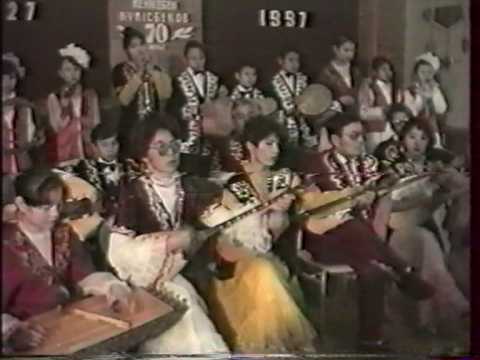
At the end of November, the jubilee evening in Kumysbekov’s homeland of Korgalzhyn took place without him. A television film by the Akmola Television and Radio Company shows a portrait and two dates in the hall — 1927 and 1997. The essential thing had changed between the April poster and these images: the man whom people had planned to honour was now being remembered. How did the organisers remake the evening after the composer’s death — and why did they abandon the largest hall?
Four months of preparation
Kulyash Baidauletova, the district deputy akim — a deputy head of local government — told the camera that preparations had begun four or five months earlier. Kumysbekov was alive then, and Korgalzhyn intended to hold a concert marking his seventieth birthday. After his death, the jubilee had to become an evening of remembrance.
Baidauletova spoke of one idea that changed during its preparation. The original plan was to hold the evening in the central Palace of Culture, which seated five hundred people. The organisers then chose another place.
Instead of five hundred seats
The evening took place at the children’s music school named after the singer Rabiga Yesimzhanova. More than ninety pupils studied there. Baidauletova explained the choice of the school itself: Kumysbekov’s love for his native land and his care for education were to remain in the children’s memory.
In the film, the account of the composer is followed by his works performed by the school’s pupils and teachers. Two documented facts stand together in this sequence: Baidauletova connects the choice of hall to the children’s memory, and the children and their teachers perform Kumysbekov’s music.
Among the invited guests was Zheksembek Yerkimbekov — an Honoured Art Worker of Kazakhstan and former Minister of Culture of the republic. He spoke of Kumysbekov as a composer who knew the folk song and kui, the Kazakh instrumental piece, from within and raised them to the level of professional musical culture. His assessment sounded beside the performances, the voice of someone who knew the professional stature of this music.
The family in his native region
The composer’s wife Asiya and his sons Nurlan and Yerzhan came to the evening. Asiya thanked the district administration, cultural workers, local people and young musicians on her own behalf and on behalf of the children. The couple had last visited these places together in 1994. Now the family returned at the district’s invitation for an evening Kumysbekov did not live to see.
At the end of the film, shapan — traditional long coats — are presented to the family and guests, and then the music continues. The images preserve speeches by people who knew Kumysbekov and performances of his works. This is no longer the concert devoted to a living composer that had been planned several months earlier: Baidauletova explicitly calls the event an evening of remembrance.
What remained of the jubilee
In the April documents, the seventieth birthday was a date in a living man’s life: the address “Dear Kenzheke,” a concert devoted to the composer, the participants in a forthcoming performance. In the November hall, the same seventy years stood beside a portrait and the year of death. The jubilee was not cancelled: it took place in another form, as an evening of remembrance.
Five hundred seats remained the original plan. The evening took place among more than ninety pupils at the music school. A celebration prepared for a living composer became an evening of remembrance after his death. The dates remained on the wall. Music remained in the hall — now performed by the next generation.