A conductor standing before an orchestra should be almost unnoticed: the listener’s attention belongs to the music. A former student recalled this advice from Kenzhebek Kumysbekov in the television programme Personality. He remembered five years of study as exacting work on the meaning and character of a composition.
Kumysbekov trained musicians at the Kurmangazy Conservatory in Alma-Ata, a higher music education institution in Kazakhstan. He taught conducting, instrument studies and orchestration. Each subject raised the same question: how could a teacher help a student understand a work and make their own decisions about its sound?
Letting the orchestra speak
The former student interviewed in Personality dated their first meeting to September 1973. Several students joined Kumysbekov’s class at that time. For five years, the teacher followed their progress closely and carefully checked their preparation. Respect for him grew alongside sustained work.
The demand to understand a composition deeply had a practical consequence. Sweeping gestures alone achieved nothing. A conductor had to bring about such unity that the audience felt the music was flowing of its own accord, the orchestra playing without visible effort from outside. The student said this advice continued to help him in his professional life.
Their relationship outlasted graduation. Kumysbekov attended his former student’s concerts. In 1992, when the student became a chief conductor, Kumysbekov gave him a book with a wish that he serve Kazakh music. The teacher could now see the results of his lessons from a seat in the audience.
Knowing what an instrument can do
Conducting or writing for an orchestra requires an understanding of what each instrument can do. Instrument studies covers its construction, range, tone colour and playing possibilities. Orchestration addresses the next question: how to distribute musical material among the instruments so that they form a shared sound.
Dombra player and conductor Ykylas Nurgaliyev, who studied at the conservatory from 1979 to 1984, named Kumysbekov as his teacher of instrument studies. He spoke about this in an interview with the newspaper Turkistan. After graduating, Nurgaliyev worked at the al-Farabi Institute of Culture in Shymkent, then became artistic director and chief conductor of the Adyrna folklore and ethnographic ensemble. Knowledge of instruments served him both in education and on the conductor’s podium.
The composer Yermurat Usenov also recalled studying instruments with Kumysbekov in an interview with Musicnews. The conductor Yerkin Nurymbetov, who entered the conservatory in 1992, named both subjects: instrument studies and orchestration. In his account to the news agency Kazinform, he linked them to two teachers, Kumysbekov and the composer Bazarbai Zhumaniyazov. Nurymbetov later worked as a dombra player and conductor in the Kurmangazy Orchestra.
Freedom within the craft
A student sent to study from Khakassia remembered another side of Kumysbekov’s teaching. In Personality, she described the freedom he gave her imagination, offering guidance in her orchestration work. His wisdom and calm remained part of her memory alongside the subject itself.
More than sixty specialists
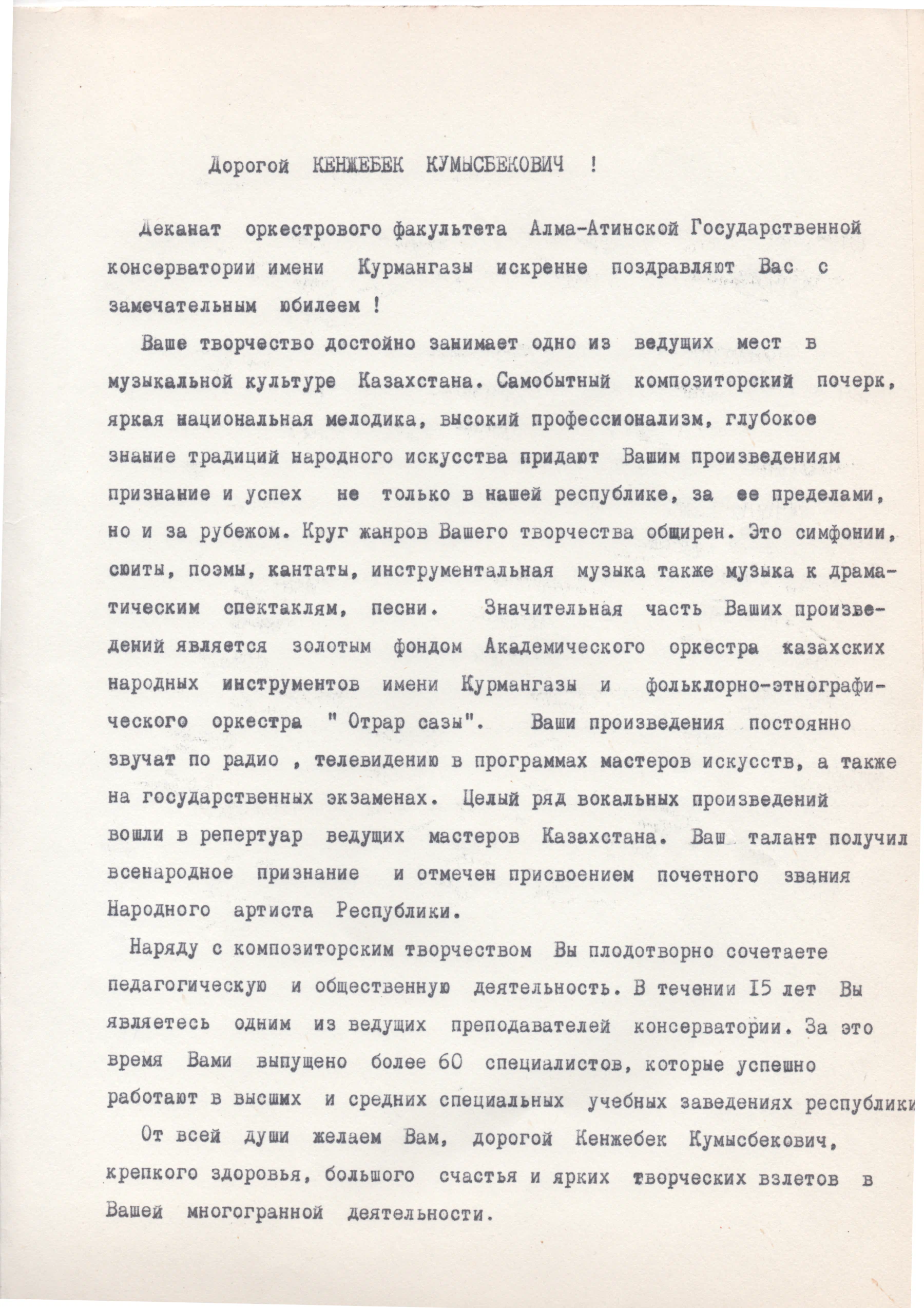
In a jubilee letter to Kumysbekov, the dean’s office of the conservatory’s orchestral faculty summed up fifteen years of teaching: more than sixty specialists trained. They were working in higher and secondary specialist education across the republic. In 1986, Kumysbekov was awarded the academic title of professor in the Department of Orchestral Conducting.
The work of one teacher thus continued far beyond his classroom. His graduates taught others, led ensembles and stood before orchestras. Alongside the subjects, their memories retained a standard of professional work: know the instruments, understand the composition, and ensure that the listener hears the music.